
This op-ed, written by Eli Pivnick, was originally published in Castanet on May 12, 2026.
Forests are the lungs of our planet.
Global greenhouse gas emissions have risen each year since the beginning of the industrial revolution. However, they peak in spring, then drop from May to October, before beginning to rise again. The summer drop is due to the photosynthesis of forests and other plants in the north temperate zone absorbing CO2. Summers in the southern temperate zone do not absorb CO2 to anywhere near the same extent because the temperate land mass is much bigger in the north as compared to the south.
Forests typically absorb 30% of GHG emissions which arise from fossil fuel burning, according to a study published in 2025 by the World Resources Institute. However, in 2023 and 2024, only about 8% was absorbed. That was due to the massive forest fires that occurred world-wide in those two years belching four billion tonnes of GHG emissions.
In 2023, Canada was responsible for 65% of global tree loss due to fires and 79% of global forest fire emissions. The higher rate of emissions compared to tree loss was due to burning into deep layers of carbon-rich peat moss in Canada’s north. In 2024, Canada was still responsible for a third of global tree loss due to fires.
Forest fires have increased world-wide due to climate change, as was been predicted prior to 2000.
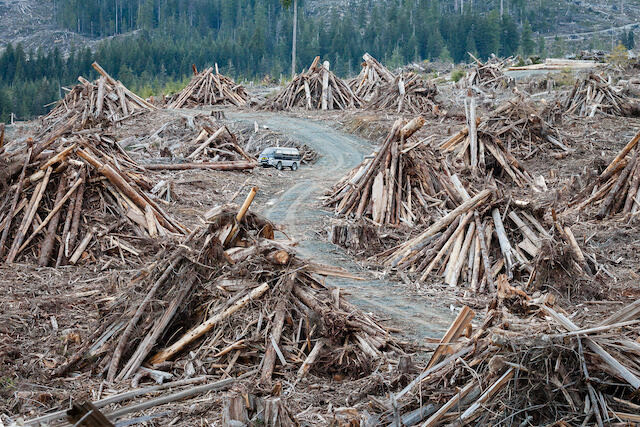
Clear cuts are a major factor in increasing forest fires. Researchers in Canada, the U.S. and Australia found wild fires are twice as likely in tree plantations than in intact forests. In western North America, clear cut areas—whether replanted or not—have an increased fire risk for at least 40 years. This is because a recent clear cut has no shade, which makes the area hotter and drier, no tree roots or rotting logs to hold moisture and new regrowth of conifers is very flammable.
On a global scale, the ability of forests to absorb carbon is declining. One eighth of forest cover has been lost in the last quarter century and much more has been degraded.
In B.C., 42 million tonnes of GHG emissions per year are due to logging (up to twice as much lost as the amount in merchantable logs) and another 26 million tonnes are not absorbed as the forest grows back. For 13 years after a clear cut, forests are still a source of carbon as decomposition emissions are greater than carbon absorption from forest growth.
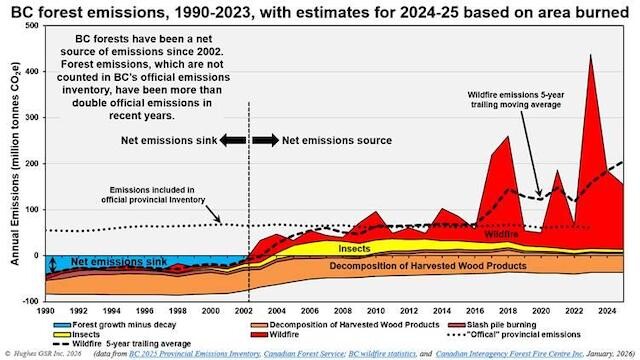
The graph below illustrates how BC forests are faring. It was produced using B.C. government data by David Hughes, an energy analyst who worked for the Geological Survey of Canada for 32 years as a research scientist.
You can see that, since 2003, B.C. forests have become a carbon source, emitting more than they are absorbing. That is primarily due to the increase in forest fires, but also the ability of forests to store carbon being compromised by the great extent of logging that has occurred. Note, along with warmer summers, one of the prime drivers increasing forest fire risk in B.C. is recent clear cuts.
One of the most concerning aspects of the graph is the black line of small dots. That is the officially reported GHG emissions in B.C. Not only are they not going down, they are increasingly dwarfed by the GHG emissions from our forests.
In some jurisdictions, forest carbon absorption is still strong, notably in China and in the eastern U.S. In the US Appalachian region, forests have been allowed to recover from logging and agriculture. More forests are retained for watershed protection and wildlife habitat.
The recommendations of the World Resources Institute for restoring healthy forests are (in order of importance):
- Protect primary forests and allow secondary forests to regenerate. While primary forests include old growth, they also include forests damaged by fire or insects as long as they have never been cut. Even after a fire, forests still retain a lot of carbon and will recover far more quickly if not logged.
- Reduce fire risk. That includes reducing the incidence of human-caused fires and] fire-resilient restoration. Among other things, it means the practice in B.C. of spraying herbicide to kill deciduous trees must end. Those trees are far less susceptible to fires than conifers.
- Better forestry. Use longer harvest rotations, cut less and plant species better adapted to hotter, drier conditions.
- Accelerate natural and assisted restoration of degraded forests.
- Support Indigenous and local people to have a greater role in forest management. In B.C., leaving Indigenous people in charge of forests without funding alternatives to clear-cut logging is not acceptable.
- Make climate change data timely and actionable. The graph demonstrates how urgent the situation is in B.C.
- Cut fossil fuel emissions. It should be obvious that LNG projects are not the way of a healthy future.
Leave a Reply