
This piece was originally published on Castanet on September 30, 2025.
Do you remember the hydrological cycle that you learned about in school?
Rain and snow fall from the sky. Tree leaves and branches slow the fall of rain. In the spring, snow slowly melts, the melt slowed because trees shade the snow and cool the air. Some of the rain and melted snow infiltrate deep into the ground, aided by the presence of tree roots, to become part of the ground water that flows downhill, slowed by tree roots. Some rain and melted snow run off directly into creeks which flow into rivers and lakes and finally into the ocean. Transpiration from tree leaves, and evaporation from the land, lakes and ocean return the water to the sky and the cycle starts over again.
But wait. Remove a major part of the trees from the cycle and what happens? Rain and snow land directly on the ground. Less rain infiltrates the soil and, with no tree roots, what ground water there is flows downhill more quickly.
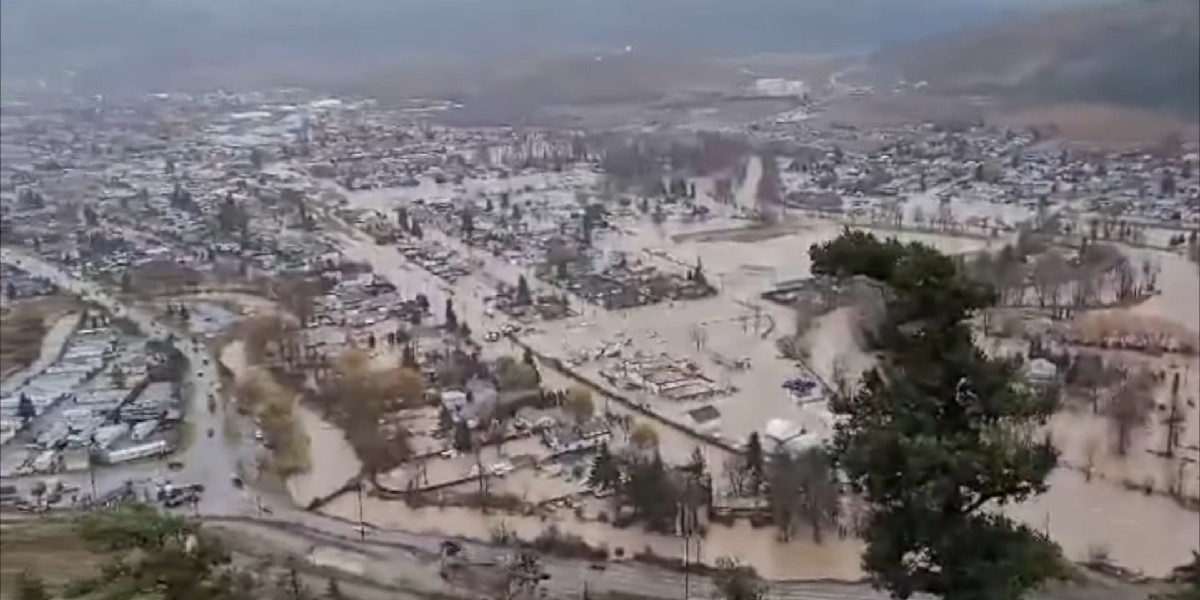
In the former forest, now a recent clear cut, there is no shade and no cooler air. Now the snow melts more quickly, infiltrates less into the soil, producing a shorter, more intense spring run-off, increasing the probability of spring floods and landslides, and summer droughts. The drier clear cut areas combined with more common drought conditions increase the risk of wildfires.
I have examined the stream flow data for Bessette Creek in Lumby (26 km east of Vernon) from 1983 to 2022. There, the spring runoff used to be split between May and June. In the last 10 years runoff occurs most often in May and there are therefore more intense flows than in the past, and more frequent spring flooding. Yes, floods, landslides, droughts and wildfires are increasing in frequency and intensity in B.C. due to climate change but the state of our forests due to logging practices are a major contributing factor.
Since 1992, UBC forest hydrology professor Dr. Younes Alila has studied the relationship between clearcut logging and its effects on the hydrological cycle in B.C. He has felt for a long time the hydrology paradigm used by the forest industry was deeply flawed. Now there is a 2025 documentary film, Trouble in the Headwaters, by film-maker Daniel J. Pierce, which centres on Alila’s research into the flooding that occurred in Grand Forks in 2017 and 2018 due to exceptionally high waters in the Kettle and Granby Rivers.
The town has since embarked on a $55 million flood mitigation project, funded mainly by the provincial and federal governments. In the most chilling moment of the documentary, Alila opines that the flood mitigation project is unlikely to be successful in every year because of the extreme amount of clear cutting in the area combined with the worsening impact of climate change.
Alila’s research has consequences. In 2015, he acted as an expert witness to help a B.C. rancher successfully sue a forestry company for its logging operation that flooded and destroyed 35 hectares of his land. In 2022, he acted again as an expert witness and helped a couple win a $300,000 settlement against the B.C. government. The suit was launched because of two floods in a six-year period on their acreage south of Smithers. The court agreed they were contributed to by nearby clear-cut logging and associated activities. Alila is currently working on another law suit.
When Trouble in the Headwaters was screened in Kelowna on Sept. 4, a panel including Alila and Pierce was convened for comments and a question and answer session after the film. One of the panelists was former Liberal MLA for Prince George-Mackenzie and former solicitor-general, Mike Morris, who authored a publication in 2020 on the state of B.C.’s forests.
I asked Morris why the hydrology research presented in the film was thought to be new information. I pointed out the B.C. Ministry of Forests in 1992 set limits of clear-cutting to between 20% and 30% of the equivalent clearcut area (ECA) of any watershed.
ECA defines an area that was clearcut and not yet regrown enough to be effective, hydrologically speaking.
His answer was, first, the ECA was not correctly defined. (Alila found that after clear cutting, it takes 60 to 80 years before a regrown forest can again play its hydrological role.) Second, the B.C. Forest and Range Practices Act of 2004, which sets forestry policy (it is still in force, although it has been, and will be, amended), was written with the guidance of the forest industry so there were few logging restrictions in law.
According to Morris’s 2020 report, numerous watersheds have exceeded 50% ECA.
It is clear that we need a substantial reduction in logging in B.C. and a move away from clear cutting as soon as possible, to let our forests slowly recover.
Unfortunately this is not the direction the current B.C. government is heading, where they are looking to increase the annual rate of logging.
Article discussion
Eli’s article generated a good discussion on the Castanet forums. One of our members, Roy Schiesser, had this to say:
“Eli clearly makes the point that we need to change how we manage declining natural and fully functioning ecosystems.”
A friend of Roy’s followed this with, “When will we learn?”
Roy responded with:
”We understand the basics, enough to know better. What we lack are leaders with integrity and a moral compass.“
Eli lives in the north Okanagan near Vernon and has a PhD in insect ecology from Université Laval in Quebec City. He has conducted insect research in the Canadian Prairies for the National Research Council, Agriculture Canada and Parks Canada. He has worked as a wilderness guide and wilderness skills instructor and has explored many parts of Canada by canoe.
He recently retired from 20 years of teaching high school, mainly on First Nation reserves in northern Ontario and in Saskatchewan. He currently spends a lot of his time working with two Vernon-area environmental groups, writing, educating, lobbying and organizing for climate action. He is a dedicated hunter, angler, forager, birder, canoeist, and skiier and is happiest in Nature.

Leave a Reply